So, recently, Stop Abuse Campaign came out with a featured story, titled, "Top Ten Things You Learn by Listening to Survivors." As a survivor, MAP, and advocate, I have some issues with some of what they share, but I found this particular story informative. It helps me to hear the stories and perspectives of survivors I have never met, because I am an introvert and the support group I attended for many years was a rather small one. This limited my exposure to other survivors, and these days, the most interaction I have with other survivors is through my advocacy.
I Am A Survivor
In case you did not know, I myself am a sexual abuse survivor. I do not talk about it much, because it is not the abuse itself that has affected me overmuch, it was my struggle to find resources for coping with my pedophilia that affected me more. The abuse tweaked my beliefs more than it traumatized me. So, I think what I say here has validity to survivor concerns, as well as ending sexual abuse.
Thing Number One: Learn The Facts And Cite Them Properly
The first thing that abuse survivors who advocate seem to have an issue with is letting the facts speak for themselves, as well as stating something as fact and then failing to cite the source for it somewhere in their material, or in a visible enough location that anyone can find it. Sometimes, survivor advocates push policies that have no basis in fact. Other times, they cherry-pick the statistics they cite.
Sometimes, bad information is to blame, and organizations cite the source properly, but the source turns out to be a bad apple or outdated. In example, for years, Gene Abel was treated as the end-all solution to issues related to pedophilia, and much of his "research" was cited on many sites. To this day, his "research" is cited on Darkness to Light's statistics page in saying that, "Pedophilic offenders often start offending at an early age, and often have a large number of victims (frequently not family members)". We now know that Gene Abel was full of garbage, and he has an entire Wikipedia page almost entirely on how he is a quack.
Other times, popularity takes a role: Sex offender policies have been particularly popular with the public, and so they get pushed more frequently because they have public support, even though there is an utter lack of research supporting the effectiveness of sex offender policies (feel free to do your own homework: "effectiveness of sex offender registration" and "effectiveness of Megan's Law" should help get you started).
Thing Number Two: Include More Perspectives Besides Survivors
The fact that I am a MAP in addition to being a survivor colors how I look at preventing sexual abuse. Sometimes, the voices in academia are ignored because they use complicated language and propose ideas that are downright unsettling. However, these are people who have dedicated their lives to figuring out why sex crimes happen so that they can be prevented. It is also important to have voices from the academic world coloring our perspective, because they see the data and trends firsthand and can give us practical solutions we might not otherwise consider.
I know many stories of people who wrestled with pedophilia, and ended up hurting a child because they did not have resources available to them. While that is no excuse, it means that referring to abusers as pedophiles actually hurts prevention efforts by giving pedophiles the idea that they will inevitably hurt a child (an idea that can not only be severely damaging, but turn into self-fulfilling prophecy).
Survivors also push for harsher sentencing, despite overwhelming evidence that sex offenders eventually make their way back into our communities, and mostly never commit another crime. The harder we make it to get back into the community, the easier we make it for them to commit another crime because we give them more reasons to give up on a fulfilling life. While it may be difficult for survivors to imagine seeing the perspective of an ex-offender, I think it is necessary because it gives us a face-to-face look at what we can do with the policies we push for.
Thing Number Three: Realize Not All Abused Children React The Same Way
This is basic, but each survivor is different. Just because another survivor has a differing view of their abuse, and abuse as a whole, does not make that view less legitimate. Just because someone's abuse seemed less bad than your own or someone else's does not mean that their abuse did not affect them. We should give each other space to hold our own views, and give each other the space to share - or not share - how abuse has affected us.
As survivors, we must also avoid perpetuating the myth that most victims go on to abuse children, because that is not what the facts say. The research is very clear: Around 50-60% of abusers claim to have been abused, and studies that use polygraph find that only 30-40% of sexual abusers have been sexually abused. We would expect a much higher rate, and more abusers for each victim, if most victims go on to abuse children. Instead, we find that there are more victims for each abuser.
Thing Number Four: Pedophilia Is Not Abuse, Pedophiles Are Not Abusers
This may be a nuance distinction for some, but pedophilia is best understood as a sexual attraction to children. It is not synonymous with sexual abuse. Multiple sources attest to this: James Cantor, Elizabeth Letourneau, Michael Seto, and Ian McPhail are just a few of the many researchers that recommend against conflating a sexual attraction with sexual abuse. Likewise, a pedophile is someone with a sexual attraction to children, which has no bearing on whether someone will harm a child. One-third of sexual abusers have pedophilia, the majority do not have pedophilia.
This wades close to the uncomfortable topic of what motivates sexual abuse, but it is not sexual attraction or sexual pleasure in most cases. In most cases, sexual abuse is motivated by unmet mental health needs in someone who does not have an adequate support system. These unmet needs vary greatly, from having pedophilia and not having the adequate support to face that, to juveniles who have been abused and are acting their abuse out on a younger child.
If we ignore the motivations of abuse - and yes they are uncomfortable to pay attention to, and no they do not justify sexual abuse in any form - then we can enable abuse to occur by driving people towards the very things that motivate sexual abuse and other crimes. By inferring that someone with a sexual attraction to children is doomed to abuse them, we put them in a worse psychological state that can fuel the very thing we want to avoid: The abuse of a child. As someone who was damaged by that inference, I believe we must end the myth that abusers are pedophiles and pedophiles are abusers.
Thing Number Five: ACE Scores Are Not Just For Victims
Yes, you read that correctly. There has been much discussion in survivor and prevention circles around the impact of ACEs, or Adverse Childhood Experiences as it pertains to their frequency in the general public, and the severe harm they can inflict on people. However, what we have been ignoring is just how much ACE scores also correlate to crime. Recently, Jill Levenson and several of her colleagues have been looking at sex offenders and general offenders who have ACEs.
Their findings firmly establish that we must focus prevention differently. As you view the chart below, bear in mind that the PINK line is the original ACE study, the GRAY line is adult sex offenders, the ORANGE is juvenile sex offenders, and the BLUE is juvenile offenders of any kind.
In other words, while generally many people have no or only one ACE and that goes down as you increase the ACE score, the opposite is true for adult sex offenders, juvenile sex offenders, and juvenile offenders in general. Their research shows that 97% of sex offenders have at least one ACE in their background, and many of them have four or more ACEs.
What this means is not only that sexual abuse must end, but that the key to ending sexual abuse is by caring for youth with ACEs with trauma-informed care, mentoring programs, and community engagement. We must reach them with the resources they need to overcome the trials they faced in childhood, and help them. This is primary prevention at work. While ACEs are a fascinating subject, there is much to be learned about them and their impact on difficult issues like sexual abuse.
We Must Improve So That Sexual Abuse Can End
Humanity has done some of its greatest work when we collaborate, network, and work with other human beings of differing perspectives. The issue of child sexual abuse is not simple, and some abuse is indeed (as much as we hate to admit this) inevitable.
However, if we can put our heads together - the civil rights advocates that state that sex offenders are people too, the abuse survivors who were directly affected by sex crimes, the people who have a sexual attraction to children and want help instead of judgment, the researchers who study sex crimes and policies that might end them, and the policymakers themselves who can guide working policies...
If we can all come together, look at this issue, and see all of these perspectives and come up with ideas for ending sexual abuse, then we stand a much better chance at making real change happen. As it is, we are bickering among ourselves about who has the best method, and children are paying the price for it. I think we need to stop bickering and put our heads together.
Showing posts with label Pedophiles. Show all posts
Wednesday, October 4, 2017
Saturday, June 17, 2017
What You Do Not Know About Pedophiles Could Spare Children Sexual Abuse
Many, many times our knowledge of something is incomplete. When that happens, we avoid taking an action when we would do so with that knowledge we are missing. We can also take action when we would not do so with that knowledge we lack. Worse, we can take action based entirely on how we feel, which can lead to disastrous consequences.

So how does that play out in the case of child sexual abuse, pedophiles, and pedophilia? I am going to run with two scenarios. There are more, but I think two are sufficient to make my point about pedophiles.
Ready?
Scenario One
So, a male friend comes to you and tells you that they are a pedophile, that they have sexual attractions to children. To you, a pedophile is someone who molests children. You ask him who the victim was. He says there was no victim. You are baffled, because a pedophile is someone that molests children. The conversation ends, rather awkwardly.

The scene rubs you the wrong way, so you ask some people about it. They tell you the guy always seemed creepy, and so you call the police and tell the police what he told you. You know this guy is always hanging out with this one kid, and after calling the police, you ask this one kid if the guy has ever touched him in an odd way. The kid says yes, he has. So the police come, you tell them what the child said, and the police interview the child. The child repeats that the guy has touched him in an odd way.
So the police arrest the guy, and the guy takes a plea deal and spends ten years on probation for molesting a child. Only… he does not finish his probation. His probation gets violated because he cannot find a job, and decides to talk to children anyway. He becomes sexual with one of them, and gets caught for molesting a child.
Scenario Two

Very similar to the first scenario, a male friend tells you they have pedophilia, and they are a pedophile because they have pedophilia. You are shocked, and you want to know what pedophilia is, because it sort of sounded like he was emphasizing the fact that he had pedophilia.
So you pull out your phone, and you look up what pedophilia is, and you see on Wikipedia that it is:
A psychiatric disorder in which an adult or older adolescent experiences a primary or exclusive attraction to prepubescent children.
You go on to read that:
In popular usage, the word pedophilia is often applied to any sexual interest in children or the act of child sexual abuse. This use conflates the sexual attraction to prepubescent children with the act of child sexual abuse, and fails to distinguish between attraction to prepubescent and pubescent or post-pubescent minors. Researchers recommend that these imprecise uses be avoided because although people who commit child sexual abuse sometimes exhibit the disorder, child sexual abuse offenders are not pedophiles unless they have a primary or exclusive interest in prepubescent children, and the literature indicates the existence of pedophiles who do not molest children.
You sort through the academic gobbledegook and look up what sorts of sexual therapists there are in your area, and tell your friend… you are sorry he is facing that disorder, and you want to help however you can. You understand that a disorder is something that people do not choose and cannot help, and you want to be there for your buddy.
What Just Happened There?
What you just witnessed are two very different reactions to something that is really not very common: Someone telling you that they are a pedophile. Obviously in the first scenario, there is no attempt to verify what they are saying, there is just the assumption of what a pedophile is, and the inability of the pedophile in question to explain what they mean. Maybe they are a teenager, maybe they just do not have the words. But regardless, they now have to face stigma and hate for the rest of their life because an assumption was made, and it snowballed from there… and eventually a child was harmed.
That first scenario can play out any number of ways to come to that conclusion of a child being abused. Maybe instead of the police, the person tells someone who then blabs it to everyone they know, and then it goes on Facebook… and then his life is ruined because no one will hire him, no one will house him, and he eventually turns to children to cope with his stress. Regardless of how the pedophile goes from telling their secret to being under a tremendous amount of stress, that pressure needs an outlet, and there is the chance that the outlet becomes directed at children rather than themselves.
While many times this stress is indeed directed inwards (alcohol abuse, drug abuse, depression, anxiety, lack of friends… etc), it can sometimes be directed to others… and that becomes risky. It can be directed at children, or it could impact children by viewing images or videos where they are being sexually abused.

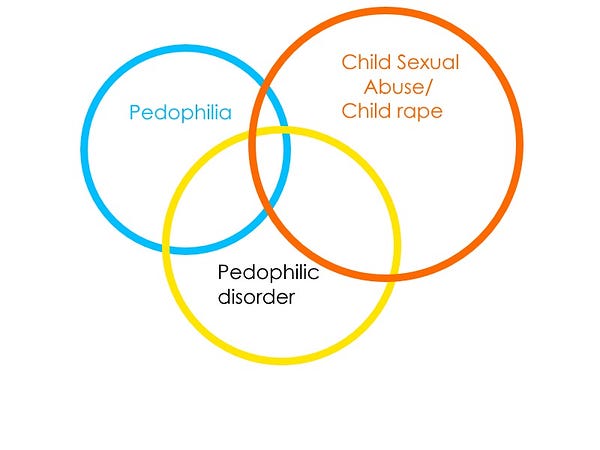
The second scenario… I fooled you. See, I set it up in a way that makes it seem like the friend did the right thing by looking up the term- which they did. However, they still found wrong information. While it is noted briefly in Wikipedia, pedophilia and pedophilic disorder are treated as two different things, and both are indeed separate from child sexual abuse.
Child sexual abuse is certainly an atrocity. But by knowing the difference between child sexual abuse, pedophilia, and pedophilic disorder, we can know how to react to each situation so that we can treat people in the best possible way. By knowing the essential information that can make all the difference in the world, we can ensure that we react properly to what we are being told… and correct others when they do not use the proper words to communicate what they mean.
But If Stress Can Be Directed Outwardly, Then…
Exactly: Not all child sexual abuse is perpetrated by pedophiles. It means that some people, who have never felt an attraction towards children in their life, can sexually abuse them. And this happens: In fact, it is more frequent than child sexual abuse that is perpetrated by pedophiles. One-third of sexual abuse is perpetrated by pedophiles, and two-thirds are perpetrated mainly by heterosexuals. So if we are to blindly judge sexual feelings as being a threat to children, then we must pin the blame firmly on heterosexuals, who make up two-thirds of abusers. See where blaming sexual abuse on sexual feelings leads? Nowhere in a hurry. So now what?

Child Sexual Abuse Is About Power, Control, And Self-Deception
Ifchild sexual abuse were about feeling pleasurably about being sexual with a child… we would expect rates of child sexual abuse to be much higher than they actually are. We know from researchers and therapists that the number of motivations and the full explanation for those motivations for child sexual abuse are vast enough to fill a fairly dense book. Even one of the best researchers in the field, Elizabeth Letourneau, was only able to narrow down the motivations for juveniles who sexually abuse children… into 19 basic items.
A list of 19 motivations is not simple to comprehend, and that is just the motivations for juvenile sexual abusers. Dr. David Finkelhor outlined a process by which someone breaks down the barriers to being sexual with a child into four basic steps, and his process is not simple either. Suffice it to say that grooming is just as much about breaking down the reluctance of the abuser as it is about the reluctance of the child.
The Best Way To Intervene
The best way to stop child sexual abuse, and intervene, is to act before the abuse happens. Some organizations advocate knowing the signs of grooming. Others focus on looking at the behavior of adults or older youth. Regardless, the focus needs to be on ensuring that those facing a significant amount of stress have the ability to handle it without taking it out on other people. We need to ensure that they have healthy self-care habits. This is true for people who react outwardly and those who react inwardly: If we can teach them how to manage the intense feelings that they are facing in a healthy way, then child sexual abuse and a variety of other ills can be reduced greatly.
Mental health is just as important as physical health.
Subscribe to:
Posts (Atom)