This is part of a miniseries about why the statistics on this site, and the
upcoming website, should matter to you, not only in your everyday life,
but in preventing child sexual abuse... before it can happen.
Statistic 1: Most Who Commit Sex Crimes Are Not Sex Offender Registrants
You have heard me cite this time and again: 95% of new sex crimes are committed by those new to the criminal justice system, stemming from a study on 21 years of arrest data in New York. Another 2015 study out of California is also significant, finding that just .6% of the 56.1% three-year return-to-prison rate were new sex crime convictions. Unless other criminals are committing sex crimes (which is not supported by the rest of the report, or general trends among sex crimes in general), it is safe to conclude that, nationwide, upwards of 95% of sex crime is committed by those with no criminal background.
Why does that matter?
Well, if the bulk of our policies on "preventing" sexual crimes are aimed at sex offenders, who are not responsible for a very high percentage of sex crimes... and we spend lots of money on these policies... then our policies are simply ineffective, and costing lots of money we could spend on more effective methods. This does not just refer to sex offender registration: Notifications of sex offenders, residency restrictions, civil commitment, and of course, juvenile registration and notification. If it targets sex offenders, the policy does very little to protect communities because it is not registered sex offenders who commit sex crimes.
Statistic 2: Juveniles Commit Sex Crimes Too...
Specifically, juveniles commit 35.6% of sexual offenses against minors. Researchers such as Elizabeth Letourneau and Jill Levenson have said that half of sex offenders were juveniles during the commission of their sex crime. Regardless of the specific figure, it is safe to say that a statistically significant portion of sexual crimes are committed by juveniles, not adults.
This matters almost as much as the first statistic, because it means that the bulk of our policies are aimed at people who committed their crimes as juveniles. While these crimes absolutely were harmful to the victims, one must wonder if punishing juvenile perpetrators for life is aiding prevention, particularly if most of them never commit another sexual crime (97%, to be precise).
Statistic 3: General Recidivism Is High, But Lower Than Other Criminals On Average
Recidivism is a much-discussed statistic, and before I touch on why a somewhat high recidivism rate for general crime (both sexual and non-sexual crimes) is high, we must first understand recidivism rates. Some studies look at rearrests, which are considered the most liberal picture of recidivism. Some studies look at returning to prison, which are considered the most conservative picture of recidivism. Still others look at reconvictions, which are a middle ground between the two. As with any crime, any recidivism statistic paints an incomplete picture of new crimes committed by offenders.
If you recall the 56.1% return-to-prison statistic from the study mentioned in the first section, it should be noted that most studies find, on average, a general recidivism rate around 30-40% for sex offenders. This means that California has a rate that is much higher than what would be considered "the norm" for sex offenders. While the very term "sex offender" encompasses a wide variety of crimes and offenders, this also means that specific types of offenders that commit specific crimes have varying rates of recidivism specific to that type or crime.
This matters, because it means there is room for much improvement in rehabilitating and successfully reintegrating sex offenders back into our communities. It means there are barriers for successful reintegration, and a need to change how we treat criminals in general. While recidivism statistics can be interpreted in a wide variety of ways depending on the study, offender, and offense, it is safe to say that in most cases, sex offenders do not reoffend, whether that is with a sexual crime or any other crime.
Statistic 4: Population Of Sex Offenders, Victims
According to the National Center for Missing and Exploited Children (whose figures are somewhat disputed among some advocates and state leaders), there are 861,837 registered sex offenders living in the United States. That is 264 sex offenders per 100,000 people. If you have followed the rest of the statistics to this point, then you can probably guess what I am about to say: Focusing our policies on nearly 1 million Americans to protect children, when most of those .862 million people are not responsible for further sex crimes means that we are creating much more damage than we are solving. How do I figure that? The math is simple.
Restated from part two, child sexual abuse, according to this source, there are 73.8 million children in the United States, and the known victim-reported prevalence is pegged at 8% for boys and 19% for girls, which translates to roughly 3,011,040 boys and 6,870,780 girls, or 9,881,820 children. The estimates that attempt to account for underreporting translate to 6,273,000 boys and 9,040,500 girls, or 15,313,500 children. In other words, our best data and estimates indicate that 13.39-20.75% of children are sexually abused (which is a big deal).
Running the estimates, 494,091-765,675 children are sexually abused by registered sex offenders, or repeat sex offenders, in other words. If somewhere between .6% and 5% of these 861,837 sex offenders are repeat offenders, that means that there are between 5,171 and 43,092 sex offenders that are repeat offenders.
This means that there are between 818,745 and 856,666 sex offenders who are being needlessly registered, and if we assume that each of them have 5 family members and 10 friends, that is 12,281,175-12,849,990 people that are affected by the sex offender registry without sufficient basis. Compared to the 494,091-765,675 children that are victimized by repeat sex offenders, that is a very disproportionate number, and while sexual abuse is not trivial, this means that we punish and indirectly affect about 12-14 times the number of people we need to. When you remember that somewhere between 35-50% of these people are juveniles at the time of the offense, you get an appalling number of children that are being harmed by the very laws that were formed to protect them.
Closing Thoughts
I have re-written the overview of sex offenders for the website three times now, and each time, I wonder if I am covering all of the bases or giving an overly simplistic view of sex offenders. Even writing this one post has taken me two weeks for similar reasons.
"Sex offender" is a term that encompasses a wide variety of crimes beyond rape and crimes against children, though together, these crimes make up the majority. However, the mere commission of these crimes, as discussed in the first and third statistics, does not mean the person committing them is an ongoing danger to children. Even the commission of a "child sex crime" would not appear to indicate such a danger because most such crimes are committed by first-time offenders. Covering each segment of restrictions against sex offenders is likewise complex.
Thus, any attempt to tackle the issue of sex offenders from any angle, research-based or journalist-based, will lead any reader to misleading conclusions about sex offenders.

Showing posts with label Primary Prevention. Show all posts
Showing posts with label Primary Prevention. Show all posts
Tuesday, July 4, 2017

Saturday, June 17, 2017
Why The Statistic Matters: Part One, Pedophilia
All the time, you hear statistics about a great number of things. You see them frequently here, on the blog. But you do not often see the practical application of them, and it is up to you to figure out the point of the statistic in question. Some are obvious, while others are not nearly as obvious.
Because of that, I will do a miniseries on why the statistics cited on this site should matter to you, not only in your everyday life, but why they matter to preventing child sexual abuse.
Statistic 1: Population Of Pedophiles
Current statistics (the DSM-V (the psychiatry Bible) and Michael Seto) put the population of those with pedophilic disorder as mainly being male: 3-5% of adolescent and adult males. This is, of course, an estimate. However, it is telling because pedophilic disorder is not the same thing as pedophilia: The DSM-V differentiates the two. This means that the high estimate of 3-5% of males means that even more have a sexual attraction to children. Why? Because pedophilic disorder is a very specific mental condition in which those with pedophilia, a sexual attraction to prepubescent children, have difficulties like depression, anxiety, and difficulty relating to others. It does not cover those with an attraction to teenagers, which means that the true population figure for those with attractions to children broadly is actually higher than 3-5% of males. That is about to matter even more because of statistic number two...
Statistic 2: Proportion Of Those Who Sexually Abused Children Who Have Pedophilia
The second statistic is well-known by researchers and therapists working with forensic and non-forensic populations of pedophiles: One-third of those who sexually abused children have pedophilia. Yes, one-third. This tells us a great deal of information about child sexual abuse: Mainly, that it is not about getting sexual pleasure from a child. You see, if the population of those with pedophilic disorder is an estimate and a low one, but the proportion of abusers with pedophilia is proportionately higher than that estimate (6-15 times higher). This means there is something associated with the attraction that drives the motivating factors that fuel the decision to abuse a child.
Statistic 3: Most Who Have Pedophilic Disorder Do Not Abuse Children
If you were to read through the section on pedophilic disorder in the DSM-V, you see a rather bleak picture of a person tortured by their attractions to children. When you get to the differential diagnosis section, you see that pedophilic disorder can correlate to alcohol and substance abuse, obsessive-compulsive disorder, and even antisocial personality disorder. When you get to comorbidity, you see that pedophilic disorder is correlated to depression, bipolar, and anxiety disorders... while they also note that these observations are only among forensic populations of those with pedophilic disorder, meaning that more study is needed in this area.
You have heard me state on this blog before: Given our best estimates without trying to compensate for underreporting, 3-5.2% of pedophiles molest children, and after accounting for that, 4.8-9.36% molest children. In other words, our best guess is that 90.64-97% of pedophiles do not molest children. This is obviously significant, because it means that a sexual attraction to children does not appear to frequently correlate with sexual abuse. It also means that what I just outlined from the DSM-V about the bleak lives of someone with a sexual attraction to children... only comes from looking at 3-10% of those with such an attraction. In other words, a lot of our information is missing about pedophilia, sexual attraction to children in general, and most importantly, it is not reasonable to correlate pedophiles with child molestation. It means that a sexual attraction to children is more common than child sexual abuse. This is frankly huge, not only for those who study pedophiles and pedophilia, but also for child sexual abuse prevention.
Statistic 4: Those Viewing Sexual Abuse Images More Often Have Pedophilia...
To be precise, 61% of those convicted of possessing child sexual exploitation material have pedophilia. What this means is that pedophiles are trying to satisfy their sexual needs with sexual material of children. This begs the question, given recent discussion around art, virtual reality, and 3-D images involving children, of whether researchers are wrong to assume that such virtual imagery serves as a gateway for a hands-on offense involving a child. If more pedophiles view sexual imagery involving real children, could that number be reduced if virtual imagery involving children were more available, and legal? Could this virtual imagery be not only a better outlet than imagery involving real children, but reduce the number of sexual abuse cases? More study is clearly needed in this area to test correlation.
Enough Statistics: What Is The Point?
The point to overviewing just these three statistics and why they matter is not merely an academic exercise: It has real implications for preventing child sexual abuse. It suggests that stigmatizing a sexual attraction to children and viewing it as a risk factor for sexually harming children is not going to be helpful to preventing child sexual abuse, because a sexual attraction to children is less often a risk factor for a hands-on sexual abuse case and more often a risk factor for viewing sexual abuse images. While viewing images of children being sexually abused is indeed harmful to the children involved, the creation of virtual images is not because real children are not involved.
These statistics also very clearly indicate that we have barely scratched the surface of knowing pedophilia and sexual attraction to children: It means more study is sorely needed in a variety of ways to uncover that knowledge. It means we should look at what happens when you give those with a sexual attraction to children support instead of an automatic and clearly incorrect label of child molester, as Prevention Project Dunkelfeld is doing in Germany. It is obvious to anyone working in these areas... they need money to do this research, and the number of people willing to put money towards this research is limited.
Bottom Line
Conflating a sexual attraction to children, which we barely know much about, with the sexual abuse of a child spreads incorrect myths that hamper our ability to prevent sexual abuse and interfere with the ability of those with an attraction to children to seek support and seek peers who face the same attraction. Mixing up the sexual attraction to children, with the sexual abuse of a child, is unwarranted, inaccurate, and only serves to enable child sexual abuse by driving both issues further into darkness and secrecy, where sexual abuse thrives.
Because of that, I will do a miniseries on why the statistics cited on this site should matter to you, not only in your everyday life, but why they matter to preventing child sexual abuse.
Statistic 1: Population Of Pedophiles
Current statistics (the DSM-V (the psychiatry Bible) and Michael Seto) put the population of those with pedophilic disorder as mainly being male: 3-5% of adolescent and adult males. This is, of course, an estimate. However, it is telling because pedophilic disorder is not the same thing as pedophilia: The DSM-V differentiates the two. This means that the high estimate of 3-5% of males means that even more have a sexual attraction to children. Why? Because pedophilic disorder is a very specific mental condition in which those with pedophilia, a sexual attraction to prepubescent children, have difficulties like depression, anxiety, and difficulty relating to others. It does not cover those with an attraction to teenagers, which means that the true population figure for those with attractions to children broadly is actually higher than 3-5% of males. That is about to matter even more because of statistic number two...
Statistic 2: Proportion Of Those Who Sexually Abused Children Who Have Pedophilia
The second statistic is well-known by researchers and therapists working with forensic and non-forensic populations of pedophiles: One-third of those who sexually abused children have pedophilia. Yes, one-third. This tells us a great deal of information about child sexual abuse: Mainly, that it is not about getting sexual pleasure from a child. You see, if the population of those with pedophilic disorder is an estimate and a low one, but the proportion of abusers with pedophilia is proportionately higher than that estimate (6-15 times higher). This means there is something associated with the attraction that drives the motivating factors that fuel the decision to abuse a child.
Statistic 3: Most Who Have Pedophilic Disorder Do Not Abuse Children
If you were to read through the section on pedophilic disorder in the DSM-V, you see a rather bleak picture of a person tortured by their attractions to children. When you get to the differential diagnosis section, you see that pedophilic disorder can correlate to alcohol and substance abuse, obsessive-compulsive disorder, and even antisocial personality disorder. When you get to comorbidity, you see that pedophilic disorder is correlated to depression, bipolar, and anxiety disorders... while they also note that these observations are only among forensic populations of those with pedophilic disorder, meaning that more study is needed in this area.
You have heard me state on this blog before: Given our best estimates without trying to compensate for underreporting, 3-5.2% of pedophiles molest children, and after accounting for that, 4.8-9.36% molest children. In other words, our best guess is that 90.64-97% of pedophiles do not molest children. This is obviously significant, because it means that a sexual attraction to children does not appear to frequently correlate with sexual abuse. It also means that what I just outlined from the DSM-V about the bleak lives of someone with a sexual attraction to children... only comes from looking at 3-10% of those with such an attraction. In other words, a lot of our information is missing about pedophilia, sexual attraction to children in general, and most importantly, it is not reasonable to correlate pedophiles with child molestation. It means that a sexual attraction to children is more common than child sexual abuse. This is frankly huge, not only for those who study pedophiles and pedophilia, but also for child sexual abuse prevention.
Statistic 4: Those Viewing Sexual Abuse Images More Often Have Pedophilia...
To be precise, 61% of those convicted of possessing child sexual exploitation material have pedophilia. What this means is that pedophiles are trying to satisfy their sexual needs with sexual material of children. This begs the question, given recent discussion around art, virtual reality, and 3-D images involving children, of whether researchers are wrong to assume that such virtual imagery serves as a gateway for a hands-on offense involving a child. If more pedophiles view sexual imagery involving real children, could that number be reduced if virtual imagery involving children were more available, and legal? Could this virtual imagery be not only a better outlet than imagery involving real children, but reduce the number of sexual abuse cases? More study is clearly needed in this area to test correlation.
Enough Statistics: What Is The Point?
The point to overviewing just these three statistics and why they matter is not merely an academic exercise: It has real implications for preventing child sexual abuse. It suggests that stigmatizing a sexual attraction to children and viewing it as a risk factor for sexually harming children is not going to be helpful to preventing child sexual abuse, because a sexual attraction to children is less often a risk factor for a hands-on sexual abuse case and more often a risk factor for viewing sexual abuse images. While viewing images of children being sexually abused is indeed harmful to the children involved, the creation of virtual images is not because real children are not involved.
These statistics also very clearly indicate that we have barely scratched the surface of knowing pedophilia and sexual attraction to children: It means more study is sorely needed in a variety of ways to uncover that knowledge. It means we should look at what happens when you give those with a sexual attraction to children support instead of an automatic and clearly incorrect label of child molester, as Prevention Project Dunkelfeld is doing in Germany. It is obvious to anyone working in these areas... they need money to do this research, and the number of people willing to put money towards this research is limited.
Bottom Line
Conflating a sexual attraction to children, which we barely know much about, with the sexual abuse of a child spreads incorrect myths that hamper our ability to prevent sexual abuse and interfere with the ability of those with an attraction to children to seek support and seek peers who face the same attraction. Mixing up the sexual attraction to children, with the sexual abuse of a child, is unwarranted, inaccurate, and only serves to enable child sexual abuse by driving both issues further into darkness and secrecy, where sexual abuse thrives.
What You Do Not Know About Pedophiles Could Spare Children Sexual Abuse
What You Do Not Know About Pedophiles Could Spare Children Sexual Abuse
Many, many times our knowledge of something is incomplete. When that happens, we avoid taking an action when we would do so with that knowledge we are missing. We can also take action when we would not do so with that knowledge we lack. Worse, we can take action based entirely on how we feel, which can lead to disastrous consequences.
So how does that play out in the case of child sexual abuse, pedophiles, and pedophilia? I am going to run with two scenarios. There are more, but I think two are sufficient to make my point about pedophiles.
Ready?
Scenario One
So, a male friend comes to you and tells you that they are a pedophile, that they have sexual attractions to children. To you, a pedophile is someone who molests children. You ask him who the victim was. He says there was no victim. You are baffled, because a pedophile is someone that molests children. The conversation ends, rather awkwardly.

The scene rubs you the wrong way, so you ask some people about it. They tell you the guy always seemed creepy, and so you call the police and tell the police what he told you. You know this guy is always hanging out with this one kid, and after calling the police, you ask this one kid if the guy has ever touched him in an odd way. The kid says yes, he has. So the police come, you tell them what the child said, and the police interview the child. The child repeats that the guy has touched him in an odd way.
So the police arrest the guy, and the guy takes a plea deal and spends ten years on probation for molesting a child. Only… he does not finish his probation. His probation gets violated because he cannot find a job, and decides to talk to children anyway. He becomes sexual with one of them, and gets caught for molesting a child.
Scenario Two

Very similar to the first scenario, a male friend tells you they have pedophilia, and they are a pedophile because they have pedophilia. You are shocked, and you want to know what pedophilia is, because it sort of sounded like he was emphasizing the fact that he had pedophilia.
So you pull out your phone, and you look up what pedophilia is, and you see on Wikipedia that it is:
A psychiatric disorder in which an adult or older adolescent experiences a primary or exclusive attraction to prepubescent children.
You go on to read that:
In popular usage, the word pedophilia is often applied to any sexual interest in children or the act of child sexual abuse. This use conflates the sexual attraction to prepubescent children with the act of child sexual abuse, and fails to distinguish between attraction to prepubescent and pubescent or post-pubescent minors. Researchers recommend that these imprecise uses be avoided because although people who commit child sexual abuse sometimes exhibit the disorder, child sexual abuse offenders are not pedophiles unless they have a primary or exclusive interest in prepubescent children, and the literature indicates the existence of pedophiles who do not molest children.
You sort through the academic gobbledegook and look up what sorts of sexual therapists there are in your area, and tell your friend… you are sorry he is facing that disorder, and you want to help however you can. You understand that a disorder is something that people do not choose and cannot help, and you want to be there for your buddy.
What Just Happened There?
What you just witnessed are two very different reactions to something that is really not very common: Someone telling you that they are a pedophile. Obviously in the first scenario, there is no attempt to verify what they are saying, there is just the assumption of what a pedophile is, and the inability of the pedophile in question to explain what they mean. Maybe they are a teenager, maybe they just do not have the words. But regardless, they now have to face stigma and hate for the rest of their life because an assumption was made, and it snowballed from there… and eventually a child was harmed.
That first scenario can play out any number of ways to come to that conclusion of a child being abused. Maybe instead of the police, the person tells someone who then blabs it to everyone they know, and then it goes on Facebook… and then his life is ruined because no one will hire him, no one will house him, and he eventually turns to children to cope with his stress. Regardless of how the pedophile goes from telling their secret to being under a tremendous amount of stress, that pressure needs an outlet, and there is the chance that the outlet becomes directed at children rather than themselves.
While many times this stress is indeed directed inwards (alcohol abuse, drug abuse, depression, anxiety, lack of friends… etc), it can sometimes be directed to others… and that becomes risky. It can be directed at children, or it could impact children by viewing images or videos where they are being sexually abused.
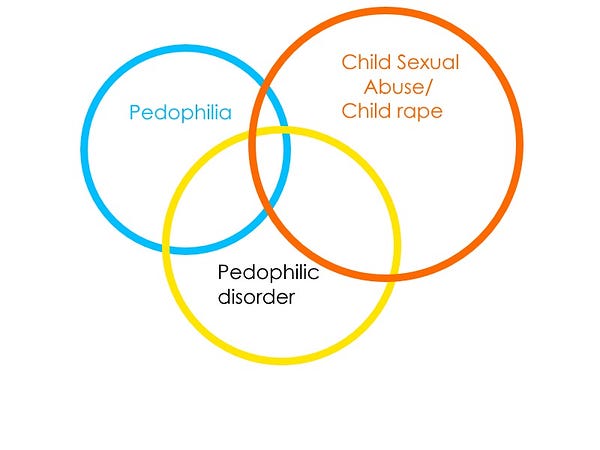
The second scenario… I fooled you. See, I set it up in a way that makes it seem like the friend did the right thing by looking up the term- which they did. However, they still found wrong information. While it is noted briefly in Wikipedia, pedophilia and pedophilic disorder are treated as two different things, and both are indeed separate from child sexual abuse.
Child sexual abuse is certainly an atrocity. But by knowing the difference between child sexual abuse, pedophilia, and pedophilic disorder, we can know how to react to each situation so that we can treat people in the best possible way. By knowing the essential information that can make all the difference in the world, we can ensure that we react properly to what we are being told… and correct others when they do not use the proper words to communicate what they mean.
But If Stress Can Be Directed Outwardly, Then…
Exactly: Not all child sexual abuse is perpetrated by pedophiles. It means that some people, who have never felt an attraction towards children in their life, can sexually abuse them. And this happens: In fact, it is more frequent than child sexual abuse that is perpetrated by pedophiles. One-third of sexual abuse is perpetrated by pedophiles, and two-thirds are perpetrated mainly by heterosexuals. So if we are to blindly judge sexual feelings as being a threat to children, then we must pin the blame firmly on heterosexuals, who make up two-thirds of abusers. See where blaming sexual abuse on sexual feelings leads? Nowhere in a hurry. So now what?

Child Sexual Abuse Is About Power, Control, And Self-Deception
Ifchild sexual abuse were about feeling pleasurably about being sexual with a child… we would expect rates of child sexual abuse to be much higher than they actually are. We know from researchers and therapists that the number of motivations and the full explanation for those motivations for child sexual abuse are vast enough to fill a fairly dense book. Even one of the best researchers in the field, Elizabeth Letourneau, was only able to narrow down the motivations for juveniles who sexually abuse children… into 19 basic items.
A list of 19 motivations is not simple to comprehend, and that is just the motivations for juvenile sexual abusers. Dr. David Finkelhor outlined a process by which someone breaks down the barriers to being sexual with a child into four basic steps, and his process is not simple either. Suffice it to say that grooming is just as much about breaking down the reluctance of the abuser as it is about the reluctance of the child.
The Best Way To Intervene
The best way to stop child sexual abuse, and intervene, is to act before the abuse happens. Some organizations advocate knowing the signs of grooming. Others focus on looking at the behavior of adults or older youth. Regardless, the focus needs to be on ensuring that those facing a significant amount of stress have the ability to handle it without taking it out on other people. We need to ensure that they have healthy self-care habits. This is true for people who react outwardly and those who react inwardly: If we can teach them how to manage the intense feelings that they are facing in a healthy way, then child sexual abuse and a variety of other ills can be reduced greatly.
Mental health is just as important as physical health.
Friday, June 2, 2017
Moore Center Sex Abuse Symposium: Part Four: Adverse Childhood Experiences And Causes Of Sexual Offending
As a refresher...
So, What Is This Symposium?
The Moore Center Symposium is a "meeting of the minds" on the prevention of child sexual abuse. It offers professionals (and advocates) an opportunity to learn more about the issue of child sexual abuse and how it can be prevented. The Moore Center for the Prevention of Child Sexual Abuse is a subset of Johns Hopkins' Bloomberg School of Public Health, which is a major educational institution in Maryland that is well-known for its work in the public health sector (as its name should indicate). The Moore Center is currently being directed by Dr. Elizabeth Letourneau, who used to be the president of The Association for the Treatment of Sexual Abusers (ATSA), and is a researcher that studies a myriad of topics within the realm of sexual abuse prevention. I am watching these admittedly dry and boring speeches to pull the essential parts out and communicate them to you. If you want to view them yourself, by all means, just be forewarned that they are dry and can be triggering.
Beginning Introductions
The symposium starts with an introduction by Johns Hopkins' President, Ronald Daniels, regarding some of the reasons for the symposium and the keynote speaker at the symposium, Patrick McCarthy, who is the president and CEO of the Annie E. Casey Foundation, an organization that focuses on improving the lives of children in a variety of ways. Other speakers at the symposium were Dr. Elizabeth Letourneau, Dr. Bruce Taylor (an expert in criminology), and Jill Levenson (expert in sociology and social work), followed by a showing of the film Untouchable, which I have talked about on this blog before. Following the film, there is a panel discussion about the film and closing remarks by Stephen and Julia Moore, the founding donors of the Moore Center.
Jill Levenson's Speech
Her speech focuses on early adverse childhood experiences and the causes of sexual offending. She starts with a handy little comic to illustrate the need to move beyond myth and current policy practices around prevention, and suggests that we need to start thinking about prevention differently.
She then gives a disclaimer that she does not want to minimize the pain done to sexual violence victims, but that it helps to have an understanding of how sexual violence happens and inform interventions. She states that there are no sides, there is no contest, and that sexual abuse victim organizations and advocates and sex abuse preventionists are not on opposing sides: Everyone is on the same team, trying to stop sexual violence. I would hope that advocates for the primary prevention of child sexual abuse, who have either been victimized by abuse, perpetrated abuse and lament it, or of any background really, are included in her team.
Public Health Model Of Primary Prevention
She starts by showing a graphic from the CDC about primary prevention where there are five areas that the CDC suggests to stop sexual violence: Promote social norms of protection, support victims/survivors, create protective environments, provide opportunities to empower and support women, and teach skills to prevent sexual violence.
She then asks what is missing from the model: Perpetrator prevention, or preventing someone from becoming a perpetrator. That is the focus of her speech. She then gives a handy demonstration of the public health model, which has three focuses: On primary prevention of universal precautions first, on secondary prevention of at-risk populations, and lastly on tertiary prevention of reacting when the problem presents itself.
Note: A handy way to think of this would be the flu: It is best to handwash and cover your mouth/nose (primary prevention - before the flu), and barring that, it is best to stay away from those that might be sick or getting flu shots to those who are vulnerable (secondary prevention - focusing on at-risk populations). The last thing you would want to do with the flu is just do nothing and wait for it to happen and then take steps (tertiary prevention).
Note: A handy way to think of this would be the flu: It is best to handwash and cover your mouth/nose (primary prevention - before the flu), and barring that, it is best to stay away from those that might be sick or getting flu shots to those who are vulnerable (secondary prevention - focusing on at-risk populations). The last thing you would want to do with the flu is just do nothing and wait for it to happen and then take steps (tertiary prevention).
She then points out that our resources and policies are currently aimed the polar opposite from what you would expect: Rather than focusing on primary, secondary, and tertiary prevention in that order, we "flip the pyramid" by focusing on tertiary prevention first, secondary second, and primary prevention last. In other words, we focus first on foster care, delinquency programs, incarceration, and sex offender registries/policies, we focus second on programs for at-risk youth and families, and improving parenting, and lastly we focus on primary prevention like changing cultural messages, reducing social problems, and reducing adverse childhood experiences (ACE's).
Overviewing The ACE Study
The Adverse Childhood Experiences study was a collaboration with the CDC and other researchers looking at family dysfunction and its causes. They originally were looking at obesity, and were noticing that many with issues with obesity had early harmful experiences in their childhood, so they did a study of over 17,000 participants to look at background challenges like abuse, family conflict, or neglect.
The survey looked at abuse, household challenges, and neglect: In abuse, they found that 21% experienced sexual abuse, 28% experienced physical abuse, and 11% experienced emotional abuse. In household challenges, they found that 13% dealt with violence towards their mother, 27% dealt with substance abuse, 19% had mental illness in the family, 23% dealt with a separation or divorce, and 5% had an incarcerated family member. In neglect, they found that 15% experienced emotional neglect and 10% experienced physical neglect.
The survey looked at abuse, household challenges, and neglect: In abuse, they found that 21% experienced sexual abuse, 28% experienced physical abuse, and 11% experienced emotional abuse. In household challenges, they found that 13% dealt with violence towards their mother, 27% dealt with substance abuse, 19% had mental illness in the family, 23% dealt with a separation or divorce, and 5% had an incarcerated family member. In neglect, they found that 15% experienced emotional neglect and 10% experienced physical neglect.
They found that 36% of their sample had zero ACE's, 26% had one ACE, 16% had two ACE's, 9% had three ACE's, and 12% had at least four ACE's. Those numbers are about to be very important, but notice that in the original ACE study, they found that the higher number of participants had lower ACE scores, and that percentage drops as you increase the ACE score.
In other words, at least 64% of the population had some sort of adverse childhood experience of some kind. These experiences seemed to be correlated with social issues like a disordered social environment or caretakers who are not equipped to protect them from harm.
The ACE's that people experience as evidenced in the study are just a small representation of what people actually deal with in their life. She discusses the two kinds of ACE's that people can suffer: Disadvantaged communities (discrimination, poverty, bullying, crime, and violence) and unexpected events (accidents, injuries, illness, death of loved ones, a natural disaster).
She discusses the three different kinds of issues that are correlated with various mental health problems: Chronic events, multiple events, and cumulative events. She goes on to talk about the lasting effects that ACE's can have on people: Health issues (diabetes, obesity, depression, STD's, heart disease, cancer, stroke, COPD, broken bones), behaviors (smoking, alcoholism, drug use), and life potential (graduation, academic achievement, lost time from work). The ACE study found that the higher the ACE score, the more issues that come up.
Dr. Levenson's Study: Looking At ACE's and Sex Offenders
Dr. Levenson's Study: Looking At ACE's and Sex Offenders
Dr. Levenson was interested in these effects, and what the backgrounds of sex offenders might look like with the ACE study in mind. So she and a few others did a study on that (Adverse Childhood Experiences in the Lives of Male Sex Offenders, Levenson, Willis, and Prescott, 2014). What they found was that sex offenders had a much higher number of ACE's in their background than general population males in every single category they studied.
When they broke down how many ACE's the male sex offenders reported, they found that 15.6% of sex offenders had zero ACE's, 13.7% had one ACE, 12.8% had two ACE's, and 12.3% had three ACES, which so far is in keeping with the original ACE study: Higher ACE scores are associated with lower percentages. However, instead of finding a lower percentage than 12.3% for sex offenders with an ACE score of 4+, they found a whopping 45.7% did... compared to 9% for general (non-sexual) offenders.
She then looked at specific states, such as Texas (Obstacles to Help-Seeking for Sexual Offenders, Levenson, Willis, and Vicencio, 2017), which generally found very similar results to the original 2014 study. She also looked at the ACE scores of female sex offenders (Adverse Childhood Experiences in the Lives of Female Sex Offenders, Levenson, Willis, and Prescott, 2015), which again found similar results to the original 2014 study..
She looked in two other studies (Levenson and Socia, 2015, Levenson and Grady, 2016) studies at the correlations between ACE's and five areas: Criminal versatility (different types of arrests), persistence (quantity of arrests), sexual deviance, sexual violence, and substance abuse. She wanted to know which ACE's correlated with which of the five areas, finding that more sex crime arrests correlated with domestic violence, child sexual abuse, and emotional neglect, and that more general arrests were associated with substance abuse, unmarried parents, and an incarcerated family member.
She also overviews a study that featured in the OJJDP Journal of Juvenile Justice (The Prevalence of Adverse Childhood Experiences (ACE) in the Lives of Juvenile Offenders, Baglivio at al, 2014, p. 6-23) looking at the prevalence of ACE's in juvenile offenders. They surveyed over 64,329 juvenile offenders in Florida finding that the lower the ACE score, the fewer offenders (male or female) who reported having them, and the higher the score, the more offenders report them, maxing out at three ACE's for males and four ACE's for females, dropping back down. This finding was again consistent with the previous three studies overviewed.
She goes on to describe the results of a new, not-yet published study, looking at a variety of demographics: Original CDC ACE study sample (pink), adult sex offenders (gray), juvenile sex offenders (orange), and juvenile non-sex offenders (blue) and found a similar trend to the previous studies. As the results are not yet published, I drew a proportionate graph:

She goes on to describe the results of a new, not-yet published study, looking at a variety of demographics: Original CDC ACE study sample (pink), adult sex offenders (gray), juvenile sex offenders (orange), and juvenile non-sex offenders (blue) and found a similar trend to the previous studies. As the results are not yet published, I drew a proportionate graph:

Sex Offenders Had It Rough. So What?
The point to all this is that both adult and juvenile sex offenders have some sort of childhood trauma, in many cases multiple traumas, that may serve as the backdrop for sexual offending. That being the case, how can we form interventions to help children with these traumas to prevent abuse, prevent maladaptive behavior, and also begs the question... what effect does this trauma have on children, and how to children react? She proposes three basic responses: Fight, flight, or freeze. When this happens, there are multiple internal reactions within the brain.
She says that these ACE's can change the architecture of the brain to create stress hormones, and they become conditioned psychologically, socially, and behaviorally to be ready for the next stressor or threat, and this limits the growth in essential processing skills areas. In other words, these events start a domino effect in the brain that, if not interfered with, can have lifelong consequences for those with ACE's in their background.
These can form beliefs and themes that are unhealthy and can lead to cognitive distortions, mental illness, and damaging patterns of thinking. Those beliefs and themes affect behavior through internal impacts that lead to impeded self-regulation and relational skills, two essential areas to developing appropriate behaviors that do not hurt others.
No Excuses, But Understanding For Interventions
No Excuses, But Understanding For Interventions
She emphasizes that prior trauma is no excuse for sexually violent behavior, and that the presence of ACE's can help understand how sexually violent behavior develops and thus how we can intervene. She suggests that these effects on children and the child's brain can lead to using sexual assault to meeting emotional and social needs.
In other words, ACE's that are chronic and continuous can lead to factors like distorted boundaries, distorted skills, reenacting trauma on others, turn to children that are less threatening, getting needs met through violence and power, or taught to act in certain ways. Summarized more simply, "Kids growing up in chronically adverse conditions who then later in life sexual offend are somehow using sex and sexual assault as the vehicle to meet psychological, emotional, and social needs." The point, again, is to understand why this behavior happens. She proposes that children raised in chronically traumatic conditions (ACE's) evolve: Just as mankind evolved, children from traumatic vs. healthy environments develop maladaptive vs. healthy behaviors.
She acknowledges that we know that there are children who do not grow up to abuse others despite horrific trauma, but that we need to shift our paradigm in our communities in how we look at policies so that those with trauma in their backgrounds can get the help and interventions they need.
In other words, ACE's that are chronic and continuous can lead to factors like distorted boundaries, distorted skills, reenacting trauma on others, turn to children that are less threatening, getting needs met through violence and power, or taught to act in certain ways. Summarized more simply, "Kids growing up in chronically adverse conditions who then later in life sexual offend are somehow using sex and sexual assault as the vehicle to meet psychological, emotional, and social needs." The point, again, is to understand why this behavior happens. She proposes that children raised in chronically traumatic conditions (ACE's) evolve: Just as mankind evolved, children from traumatic vs. healthy environments develop maladaptive vs. healthy behaviors.
She acknowledges that we know that there are children who do not grow up to abuse others despite horrific trauma, but that we need to shift our paradigm in our communities in how we look at policies so that those with trauma in their backgrounds can get the help and interventions they need.
How Do We Treat Trauma, And How Must Policy Change?
In wrapping up her speech, she looks at the trauma-informed approach from SAMHSA: Realizing the prevalence and impact of trauma, recognizing the symptoms of trauma, responding by including knowledge around trauma into policy, procedure, and practice, and avoiding re-traumatization.
They discuss trauma-informed care and how to treat people in light of prior trauma as a way to solve a wide variety of problems besides just sexual violence. She also suggests a top-down, bottom-up approach by policymakers and other leaders. She talks about the need for role-models and supportive people who believe in those with trauma in their backgrounds, and how immensely helpful it is to have supports for those with ACE's and the earlier the better, but also for adults. Make sure that those with trauma have access to role models, mentoring, and are exposed to adults and peers who believe in them.
She suggests that people need to feel a certain accepted, valued, connected, and empowered, and without that, they resort to crime, gangs, teen pregnancy, and self-medication. In order to counter that, we must make opportunities for attachments, meaningful pursuits, self-efficacy, and self-sufficiency.
She reinforces that while not every abused child becomes an abuser, those with ACE's are more likely to grow up to abuse others.
She goes back to the prevention pyramid from the first few slides and flipping the pyramid to focus on primary prevention, the need to teach respect, consent, and issues in creating solid gender roles, as well as focusing on secondary prevention for at-risk populations of trauma-informed care in helping those with ACE's. She also touches on tertiary prevention, which should be the smallest area of focus: Think about treatment, support, and accountability so that they can successfully lead a law-abiding life and be responsible citizens.
She goes back to the prevention pyramid from the first few slides and flipping the pyramid to focus on primary prevention, the need to teach respect, consent, and issues in creating solid gender roles, as well as focusing on secondary prevention for at-risk populations of trauma-informed care in helping those with ACE's. She also touches on tertiary prevention, which should be the smallest area of focus: Think about treatment, support, and accountability so that they can successfully lead a law-abiding life and be responsible citizens.
Thursday, May 4, 2017
A Message About Prevention For Sexual Abuse/Assault Survivors
Difficult
Subject
This
subject is difficult for me, because I was sexually abused by three separate
people growing up: A caregiver, a local teenager, and my mother were the
culprits. While that is not my entire story, and as you well know, each of our
stories is different, it has served as part of the backbone for why I advocate
against child sexual abuse. I have long since set aside using my experiences
with sexual abuse as arguments when I am advocating, because most of my
advocacy takes place on the internet, where anyone can say anything. It is much
harder to argue with verifiable facts than it is to argue with some guy with a
weird screenname talking about how he was abused.
This
is an especially difficult subject for me to cover, because not only am I
limited by my own perspective, I bury my nose in research and news articles far
more often than I bury my nose in stories of other survivors. My knowledge of
this issue is more academic than it is anything else, so there are things I
absolutely cannot relate to. In addition to that, I am not as in touch with my
emotions as I could be. Often, it takes me additional time to process how I
felt. Just yesterday, I did not realize how tired I was until several hours
after I was getting cranky.
Why
Facts Are Important
For
this, I would like to use an example that may sound a little ridiculous: Let us
say that you have a pest problem in your house, but you do not know what kind
of pest it is. You have never seen the pests yourself, only the effects:
Crumbs, torn packages, that sort of thing. Would you assume it is cockroaches,
and buy cockroach spray? Would you keep buying the spray if the pest issue
persisted? No, you would attempt to narrow down the suspected pest, so that you
know how to deal with it.
Using
this example, the first several options are preposterous. You would not use
cockroach spray on a mouse, nor a squirrel trap for a cockroach, and you would
certainly not buy more solutions for one type of pest if they are ineffective.
The best course of action would be to find out what you are dealing with, and
then take a next step, so that you can ensure that step is effective at
addressing your problem.
This
ties into preventing child sexual abuse and sexual assault perfectly, though
you would find it difficult to believe. In the 1990's, we began forming policies
to address the "pest problem" of sexual crimes without studying who
is responsible for these crimes or what impact these policies or "pest
traps" would have, and whether they would be effective in solving our
sexual crime or "pest problem". Since then, much research has looked
not only at these policies, but who is responsible for sexual crimes and what
the motivations are. We have identified who the "pests" are, and I
will come back to that in a moment.
The
results of throwing a pest solution at a pest problem of unknown origin is a
shot in the dark at best. Similarly, the results of trying to stop sexual crime
with methods that may or may not address sexual crimes are policies that may be
completely ineffective at stopping sexual crime. The implications can mean that
more victims do suffer from sexual crimes, even though the intent is less
sexual crime with fewer victims. I think at this point we can all agree that
good intentions, in this case, must be supported by effective policies as well,
so that our efforts to stop sex crimes are effective. If more people suffer the
pain of sexual crimes because our policies do not do what they are intended to
do, that is not a good situation.
Research
Is Important
With
that having been said, I think there is a lot of value in looking at the
research around sexual abuse and sexual assault prevention. In many cases, the
facts that exist in research are very counterintuitive to what most people are
likely to think about this issue, perhaps even you.
Before
I continue, I would like to list five citations for reliable research (among
the plethora that exist) that I am familiar with. While it is generally
advisable when looking at research studies to look at multiple studies on a
subject, I include these because I find them to be representative of the
similar studies I have seen, and the academic information available on the
subject.
I
will list the facts that are drawn from these later, but for now, I want to
only include the citations:
1. Sandler, J. C., Freeman, N.
J., & Socia, K. M. (2008). DOES A WATCHED POT BOIL? A
Time-Series Analysis of New York State’s Sex Offender Registration and
Notification Law. Psychology,
Public Policy, and Law, 14(4), 284-302. doi:0.1037/a0013881
2. Bonnar-Kidd, K. K.
(2010). Sexual Offender Laws and
Prevention of Sexual Violence or Recidivism. American Journal of Public Health, 100(3),
412-419. doi:10.2105/AJPH.2008.153254
4. Seto, M. C., Cantor, J. M.,
& Blanchard, R. (2006). Child Pornography Offenses
Are a Valid Diagnostic Indicator of Pedophilia. Journal of Abnormal
Psychology, 610-615. doi:10.1037/0021-843X.115.3.610
5. Buckman, C., Ruzicka, A.,
& Shields, R. T. (2016) Help Wanted: Lessons on
Prevention from Non-Offending Young Adult Pedophiles. Association for the
Treatment of Sexual Abusers Forum Newsletter, 28(2).
All
of these citations are from prestigious organizations and have been
peer-reviewed, which means that other experts familiar with these topics have
double-checked them for accuracy and methodological rigor. In other words, not
only do the authors of these studies know their stuff, the studies were
reviewed by others who likewise know their stuff. I will come back to that list
shortly.
An
Overview Of Current Initiatives And Policies
Currently,
the popular methods of stopping sex crime naturally center around tracking,
supervising, and restricting sex offenders. We put them on both public and
private lists, so that people and police in our communities know who and where
they are. We notify communities when a high-risk offender is moving in. We
sometimes prevent them from living and even being near schools, parks, bus stops,
and other places where there are children. We seek harsher sentences, in order
to deter would-be sex offenders and exact revenge on these people. Sometimes,
these sentences vary by location: Larger urban counties tend to use
rehabilitative sentences, where smaller urban counties trend towards harsher,
lengthier sentences.
Above
all of that, we state that only a monster would commit a rape, or a sex crime
against a child, and we seek to use the label of “sex offender” to insinuate
that these people are monsters. We lump all offenders who have committed a
sexual crime into one label: Sex offender.
Many
of these policies vary depending on where you live, but all of them are not
sentences, but requirements that endure after the completion of whatever sentence
the offender was given. In Wisconsin, for example, sex offenders must wear GPS
monitors their entire lives, while that is not the case in New York. In
California, residency restrictions are being overturned by judges, while in
Minnesota, many cities have passed ordinances. In some places, juveniles as
young as nine years old are placed on the sex offender registry, and juveniles
do perpetrate 35.6% of child sexual abuse cases.
The
overwhelming public opinion is that harsher is better when it comes to policies
about sex offenders.
Back
To That Research...
Remember
that research list? Here are some very short summaries about each article (in
the above order), based on their abstracts. If you wish to read the abstracts
directly, please feel free to use the links and investigate them yourself
(studies 3, 4, and 5 are available full-text while you may have to hunt for the other two).
- Sandler, J. C., Freeman, N. J., & Socia, K. M. (2008). DOES A WATCHED POT BOIL? A Time-Series Analysis of New York State’s Sex Offender Registration and Notification Law. Psychology, Public Policy, and Law, 14(4), 284-302. doi:0.1037/a0013881
- This study was a time-series analysis looking at 21 years of arrest data in New York, categorizing arrestees into several categories, determining that 5% of arrests were of registered sex offenders or those with prior sex offenses on their record, and 95% of arrests were of those new to the criminal justice system.
- Bonnar-Kidd, K. K. (2010). Sexual Offender Laws and Prevention of Sexual Violence or Recidivism. American Journal of Public Health, 100(3), 412-419. doi:10.2105/AJPH.2008.153254
- This study is an evaluation of sex offender management policies including GPS monitoring, civil commitment, community notification, registration, and restrictions on residency, internet, and others. This article looks at the consequences of these policies, and suggests that the effectiveness of these policies is in question and may do more harm.
- Finkelhor, D. (2009). The Prevention of Childhood SexualAbuse. The Future Of Children, 19(2).
- This article details many current methods of preventing child sexual abuse, concluding that efforts to punish and manage offenders are less effective than primary prevention efforts. A wide variety of methods, including sex offender registration and notification, sex offender residency restrictions, child safety education, and others are covered.
- Seto, M. C., Cantor, J. M., & Blanchard, R. (2006). Child Pornography Offenses Are a Valid Diagnostic Indicator of Pedophilia. Journal of Abnormal Psychology, 610-615. doi:10.1037/0021-843X.115.3.610
- This study is one of several vitally important studies looking at the prevalence of pedophilia in those who have convictions involving sexual abuse material, and those who have molested children. While the study’s sample size was limited, they found that 61% of those with sexual abuse material convictions had pedophilia, and 35% of those with molestation convictions had pedophilia. It is generally accepted among researchers that roughly a third of child sexual abusers have pedophilia, though there is no one study that demonstrates that.
- Buckman, C., Ruzicka, A., & Shields, R. T. (2016) Help Wanted: Lessons on Prevention from Non-Offending Young Adult Pedophiles. Association for the Treatment of Sexual Abusers Forum Newsletter, 28(2).
- This research update gave a broad overview of the Moore Center for the Prevention of Child Sexual Abuse's "Help Wanted" study, which was based on a podcast done by This American Life. In short, the study they conducted looked at the experiences of offending and non-offending pedophiles to look at common needs that pedophiles have when they are just discovering their sexual attraction to children. The entire point, which was heavily based on the story in the podcast, is that sometimes those with attractions to children are afraid they might molest a child, and the study seeks to answer the question: How can we help those people so that they do not hurt a child?
As
you can see from this information, there is a wide variety of research
available to tell us which methods of preventing and stopping sexual abuse and
sexual assault work, and which do not. Overwhelmingly, the research literature
supports preventative methods over punitive methods. The first study, and sex
offender recidivism studies, suggest that the biggest group of people
responsible for sexual crimes overall are those with no criminal background. If
interventions could reach these people before these crimes are committed, many
victims would be spared the sort of pain you had to experience.
Powerful
Voices
Child
sexual abuse victims, survivors, and their families have been powerful voices
for legislative change in the past three decades and beyond. Many of our
current policies have been the result of people like you speaking up, and
making the statement that sexual crimes should not and cannot be tolerated by
the rest of society. I wholeheartedly agree with that message that sexual crime
is unacceptable and needs to stop. However, I believe that if we are to be
effective in making that vision a reality, we must pay close attention to what
the facts and the research say. As I pointed out earlier, if we form policies
that are not based in fact, we run the risk of wasting time and resources and
creating more victims.
Taking
The Politics Out Of Prevention
The
goal of preventing child sexual abuse has been political for many years, and I
believe it need not be so. Conservatives, liberals, moderates, independents,
socialists, and everything in between: We are all human, and we all know that
when our youngest members suffer, we all suffer. The suffering of children at
the hands of other children and adults who use them for sexual pleasure needs
to stop. We can all wholeheartedly agree on that point. Can we agree that to do
so, we must focus on the facts involved in these issues, even if they are
complex and difficult to understand, accept, or believe? Can we agree that the
facts and the research are important to preventing others from knowing the pain
of sexual crimes? If we can agree on those points, then we must speak up and
let our politicians hear us: Demand that they focus on the research so that
others will not know our pain.
Advocating
Prevention Means Sex Offender Policies Must Take The Back Seat
Prevention,
particularly primary prevention, means that we seek to stop sexual crimes
before they can happen. In other words, intervening in the process that leads
someone from a stressful background or event to using someone else as a sexual
frustration outlet. That means programs need to be available for those sexually
attracted to children who fear they might one day act on it, and it means that
children need to be educated on sex, sexuality, consent, and what mental health
resources are available to them if they are struggling with an issue (any
issue, including being victimized or fearing that they might victimize others).
There are a wide variety of areas involved in primary prevention, and you can
explore all of them by reading the third study above by Dr. Finkelhor.
While
criticizing sex offender policies may seem like a bad move, the reality is that
at most, they will only ever address less than 5% of new sex crimes (the first study). Compared to primary
prevention, which can address up to 95% of new sex crime, the focus on
prevention is a no-brainer. The reality is, in addition to not being effective,
sex offender policies have been shown in some studies to increase recidivism
rather than decreasing it: In other words, they are correlated with more crime,
not less.
The Shorter
Version…
The simple version of this can be summed up in four points:
- Despite the difficulty of the subject matter, and because of it, we need to have serious and open conversations about what is and is not effective at impacting sex crime.
- Research and research-based policies need to be brought into the limelight so that future generations can avoid seeing the kind of pain that survivors of sexual abuse and assault experience.
- Current policies are focused almost exclusively on a problem that does not have much basis in research.
- Survivors of sexual abuse and assault have powerful voices that have been effective in seeing legislative changes on this issue, and if these voices speak to effective vs. ineffective policies, real change can be seen.
The future is in your hands. How will you act?
Sunday, April 30, 2017
New York Post Article About Pedophiles
So, last week, I had an article from a columnist in the New York Post come up in my news feed. I usually dismiss stuff from the New York Post, because it is usually difficult to get in contact with their authors to notify them that pedophilia and child sexual abuse, as well as pedophiles and child rapists, are four separate and distinct ideas. I do this outreach, because conflating the two minimizes child sexual abuse and unfairly stigmatizes pedophilia.
This blog has covered this distinction and why it matters several times, most recently when I was talking about Prevention Project Dunkelfeld. So, I had a brief correspondence with the writer of the article, John Crudele, about why the distinction matters, why child pornography is incorrectly named, and that the distinction can mean less children are sexually abused. The ideas I am presenting are hardly new. They have been covered in the news, by researchers, and by non-offending pedophiles themselves. Even This American Life has tackled this issue.
You can read the full text of what I wrote him (minus the links, sadly). Unfortunately, Mr. Crudele did not completely represent the bulk of the exchange in what he published, but as you can see, I did not ask him to publish it.
I especially enjoyed his threat to report me to the FBI, when I have reached out many times to legislators in Minnesota and law enforcement agencies about the facts around sex offenders, a prosecutor's office out of Long Island about not blaming victims for abuse, and yesterday, the Minnesota Department of Corrections regarding Prevention Project Dunkelfeld. I could be wrong, but I doubt anyone in law enforcement has a big issue with the advocacy that I am doing to prevent child sexual abuse before it can happen.
But there you have it, I was in the New York Post. And Mr. Crudele, if you are paying any attention to this blog post, you may want to better inform yourself about these issues. Myths do not protect children from being sexually abused and exploited, facts do, and the more myths we believe about child sexual abuse and drive it into secrecy, the more we enable child sexual abuse. I think a better situation is where children are not victimized, and pedophiles are not scarred by the idea that they are a ticking time bomb waiting to molest children. We must talk about this if we are to end abuse.
But thank you, Mr. Crudele, for presenting your readers with the ideas that I emailed you about. The more we talk about these issues, the better.
This blog has covered this distinction and why it matters several times, most recently when I was talking about Prevention Project Dunkelfeld. So, I had a brief correspondence with the writer of the article, John Crudele, about why the distinction matters, why child pornography is incorrectly named, and that the distinction can mean less children are sexually abused. The ideas I am presenting are hardly new. They have been covered in the news, by researchers, and by non-offending pedophiles themselves. Even This American Life has tackled this issue.
You can read the full text of what I wrote him (minus the links, sadly). Unfortunately, Mr. Crudele did not completely represent the bulk of the exchange in what he published, but as you can see, I did not ask him to publish it.
I especially enjoyed his threat to report me to the FBI, when I have reached out many times to legislators in Minnesota and law enforcement agencies about the facts around sex offenders, a prosecutor's office out of Long Island about not blaming victims for abuse, and yesterday, the Minnesota Department of Corrections regarding Prevention Project Dunkelfeld. I could be wrong, but I doubt anyone in law enforcement has a big issue with the advocacy that I am doing to prevent child sexual abuse before it can happen.
But there you have it, I was in the New York Post. And Mr. Crudele, if you are paying any attention to this blog post, you may want to better inform yourself about these issues. Myths do not protect children from being sexually abused and exploited, facts do, and the more myths we believe about child sexual abuse and drive it into secrecy, the more we enable child sexual abuse. I think a better situation is where children are not victimized, and pedophiles are not scarred by the idea that they are a ticking time bomb waiting to molest children. We must talk about this if we are to end abuse.
But thank you, Mr. Crudele, for presenting your readers with the ideas that I emailed you about. The more we talk about these issues, the better.
Monday, April 24, 2017
Prevention Project Dunkelfeld And Mandatory Reporting
Another Word About Terminology (Again)
It is quite normal to use the word "pedophile" to refer to someone who has sexually abused children, or to think that those with a sexual attraction to children have or will abuse children. However, neither is accurate. People with a sexual attraction to children (pedophiles) are not typically responsible for abusing children, and those that abuse children do not typically have pedophilia. By using the proper terminology, we can reduce the stigma around pedophilia and enable pedophiles to come forward for help if they need it.
What Is Prevention Project Dunkelfeld?
PPD is a German program aimed at reaching anyone with concerns about their thoughts around children. Because there is no mandatory reporting law in Germany, they are able to offer free and completely confidential help to people. While their primary target is people with a sexual attraction to children (regardless of whether those people have hurt or not hurt children, see here if you need a refresher on the distinction between child rapist/child rape and pedophile/pedophilia), it is impossible to argue with their results. Hundreds of people have come forward since the program started in 2005, and they have gone from a single site to many sites all over Germany. Their program is seeing people with sexual concerns crawling out of the woodwork to get help.
A Word About Sweden
Sweden has one of the best systems for handling crime out there: They treat their criminals like people instead of scum, and it seems that this system is paying off. While some reports might tell you that they have a much higher rate of rape and other sexual crimes compared to the United States, you must remember that rape is a highly underreported crime, particularly in the United States: According to RAINN, out of every 1,000 rapes, only 310 are reported to police, and 11 get referred to prosecutors. It is possible that Sweden's approach to crime means more people are prosecuted, and more cases are reported. Sweden has a fairly low incarceration rate because they offer help when giving people a second chance, rather than just slapping them with a sentence, a criminal record, and telling them, "Good luck rebuilding your life, we'll be watching." This begs the question of whether the United States could do better, and whether looking at Sweden, as well as Germany, could benefit us.
Why Does Mandatory Reporting Matter?
Previously, I have discussed mandatory reporting from the perspective of those who have loved ones who have abused children. What you may not realize is that mandatory reporting does not just affect people who have already hurt a child, it affects those who have not committed any crime, but fear they might be charged with one because of a misconception or false accusation. While false accusations of sexual abuse are relatively rare (4-8%), the degree to which sexual abuse is punished by law makes it a very, very scary topic for people.
Combine that with the sexual attraction to children, which most people erroneously conflate with the sexual abuse of a child, and you have a recipe for no one coming forward for help. One of the biggest emerging areas in sexual abuse prevention is the question: How do we get people with concerns about their thoughts towards children to get help before a child is hurt? Prevention Project Dunkelfeld has answered that question. While many pedophiles may already have support systems in place, it is extremely difficult. Establishing support networks for pedophiles (those with the sexual attraction, not those who have abused, remember) has been a challenge primarily because of the fear that they will be charged with a crime or investigated (and outed) by law enforcement.
Mandatory reporting also deters victims from reporting their abuse. Most people consider sexual abuse to be a heinous crime... and rightly so. But those same people also consider those who commit this crime to be abhorrent monsters, sexual predators even... when this is not the case. Around 90% of child sexual abuse is perpetrated by someone known and trusted, not just by the victim, but in the surrounding community. 30% are family members: Someone's loving uncle, father, brother, and more. 60% are people who are close friends with the family: Teachers, babysitters, coaches, and more. These are people we care about, not just an ugly monster we feel fine just locking up and throwing away the key.
That matters because the person abusing the victim is someone the victim loves and cares for, and the community around both the victim and the abuser loves and cares for both the victim and the abuser. We see a pattern in many institutional cases where a teacher or priest is known to have been abusing, and nothing is done- by adults. This outrages us because of the lack of accountability, but it gives testimony after testimony that abuse is perpetrated by known, loved, and trusted figures. This means that no one wants them to get in trouble, but everyone wants them to get help. If the only way to get them help is for the abuser to go to prison and have their life ruined, many people decide that the help is not worth it. I suggest that it is possible to hold an abuser accountable without giving them a criminal sentence for the rest of their life, and without draconian punishments. Sweden clearly demonstrates this possibility, as does Germany.
Bringing Primary Prevention To The United States
The Moore Center for the Prevention of Child Sexual Abuse is a program of Johns Hopkins Bloomberg School of Public Health, led by Dr. Elizabeth Letourneau. Since 2015, they have been working on a project that they have called "Help Wanted" which is a project designed to determine what help young adult pedophiles need, and how to reach them before they hurt a child. While some of their work ignores the reality that some pedophiles do not need expert interventions, the goal of the project is to figure out how Prevention Project Dunkelfeld could happen in the United States.
The original basis for their Help Wanted project was an episode that aired on This American Life (30 min.), which told the story of a young pedophile who tried many different therapists before joining Virtuous Pedophiles and creating his own support group. While Help Wanted seems to be exclusively aimed at helping teenagers, it is the only US-based attempt to determine how to reach potential abusers of children before the abuse can happen.
One of the biggest needs to make this kind of prevention a reality is the elimination of mandatory reporting laws, and the elimination of draconian sentencing. While there are a small percentage of sexual abusers who fit the media stereotype of being "monstrous scum" who constantly prey on children, the majority of abusers do not fit this stereotype. If we had policies and a public that recognized that fact, the United States and other countries could put a significant dent in child sexual abuse.
How Can You Help?
Contact your legislators, and link this post, or the programs linked in this post. The more people who are aware of Help Wanted and Prevention Project Dunkelfeld, the more chance there is that something can be done. It is not enough for a lone prevention advocate, and a lone prevention organization, to be saying these things. Multiple people from different areas of background (or no background at all) need to join these voices.
For most people, calling your legislators and leaving a message is far more effective than shooting off an email. Sending a physical letter will help as well. If you are unsure of who your legislators are, Google "contact my representative in [state]". If multiple people contact the same office at around the same time, they take more notice.
You can also donate money to the Moore Center and other organizations that push primary prevention, like Stop It Now! There is a heavy financial need for projects like Help Wanted, because of the number of people unwilling to provide funding on such an emotional topic.
It is quite normal to use the word "pedophile" to refer to someone who has sexually abused children, or to think that those with a sexual attraction to children have or will abuse children. However, neither is accurate. People with a sexual attraction to children (pedophiles) are not typically responsible for abusing children, and those that abuse children do not typically have pedophilia. By using the proper terminology, we can reduce the stigma around pedophilia and enable pedophiles to come forward for help if they need it.
What Is Prevention Project Dunkelfeld?
PPD is a German program aimed at reaching anyone with concerns about their thoughts around children. Because there is no mandatory reporting law in Germany, they are able to offer free and completely confidential help to people. While their primary target is people with a sexual attraction to children (regardless of whether those people have hurt or not hurt children, see here if you need a refresher on the distinction between child rapist/child rape and pedophile/pedophilia), it is impossible to argue with their results. Hundreds of people have come forward since the program started in 2005, and they have gone from a single site to many sites all over Germany. Their program is seeing people with sexual concerns crawling out of the woodwork to get help.
A Word About Sweden
Sweden has one of the best systems for handling crime out there: They treat their criminals like people instead of scum, and it seems that this system is paying off. While some reports might tell you that they have a much higher rate of rape and other sexual crimes compared to the United States, you must remember that rape is a highly underreported crime, particularly in the United States: According to RAINN, out of every 1,000 rapes, only 310 are reported to police, and 11 get referred to prosecutors. It is possible that Sweden's approach to crime means more people are prosecuted, and more cases are reported. Sweden has a fairly low incarceration rate because they offer help when giving people a second chance, rather than just slapping them with a sentence, a criminal record, and telling them, "Good luck rebuilding your life, we'll be watching." This begs the question of whether the United States could do better, and whether looking at Sweden, as well as Germany, could benefit us.
Why Does Mandatory Reporting Matter?
Previously, I have discussed mandatory reporting from the perspective of those who have loved ones who have abused children. What you may not realize is that mandatory reporting does not just affect people who have already hurt a child, it affects those who have not committed any crime, but fear they might be charged with one because of a misconception or false accusation. While false accusations of sexual abuse are relatively rare (4-8%), the degree to which sexual abuse is punished by law makes it a very, very scary topic for people.
Combine that with the sexual attraction to children, which most people erroneously conflate with the sexual abuse of a child, and you have a recipe for no one coming forward for help. One of the biggest emerging areas in sexual abuse prevention is the question: How do we get people with concerns about their thoughts towards children to get help before a child is hurt? Prevention Project Dunkelfeld has answered that question. While many pedophiles may already have support systems in place, it is extremely difficult. Establishing support networks for pedophiles (those with the sexual attraction, not those who have abused, remember) has been a challenge primarily because of the fear that they will be charged with a crime or investigated (and outed) by law enforcement.
Mandatory reporting also deters victims from reporting their abuse. Most people consider sexual abuse to be a heinous crime... and rightly so. But those same people also consider those who commit this crime to be abhorrent monsters, sexual predators even... when this is not the case. Around 90% of child sexual abuse is perpetrated by someone known and trusted, not just by the victim, but in the surrounding community. 30% are family members: Someone's loving uncle, father, brother, and more. 60% are people who are close friends with the family: Teachers, babysitters, coaches, and more. These are people we care about, not just an ugly monster we feel fine just locking up and throwing away the key.
That matters because the person abusing the victim is someone the victim loves and cares for, and the community around both the victim and the abuser loves and cares for both the victim and the abuser. We see a pattern in many institutional cases where a teacher or priest is known to have been abusing, and nothing is done- by adults. This outrages us because of the lack of accountability, but it gives testimony after testimony that abuse is perpetrated by known, loved, and trusted figures. This means that no one wants them to get in trouble, but everyone wants them to get help. If the only way to get them help is for the abuser to go to prison and have their life ruined, many people decide that the help is not worth it. I suggest that it is possible to hold an abuser accountable without giving them a criminal sentence for the rest of their life, and without draconian punishments. Sweden clearly demonstrates this possibility, as does Germany.
Bringing Primary Prevention To The United States
The Moore Center for the Prevention of Child Sexual Abuse is a program of Johns Hopkins Bloomberg School of Public Health, led by Dr. Elizabeth Letourneau. Since 2015, they have been working on a project that they have called "Help Wanted" which is a project designed to determine what help young adult pedophiles need, and how to reach them before they hurt a child. While some of their work ignores the reality that some pedophiles do not need expert interventions, the goal of the project is to figure out how Prevention Project Dunkelfeld could happen in the United States.
The original basis for their Help Wanted project was an episode that aired on This American Life (30 min.), which told the story of a young pedophile who tried many different therapists before joining Virtuous Pedophiles and creating his own support group. While Help Wanted seems to be exclusively aimed at helping teenagers, it is the only US-based attempt to determine how to reach potential abusers of children before the abuse can happen.
One of the biggest needs to make this kind of prevention a reality is the elimination of mandatory reporting laws, and the elimination of draconian sentencing. While there are a small percentage of sexual abusers who fit the media stereotype of being "monstrous scum" who constantly prey on children, the majority of abusers do not fit this stereotype. If we had policies and a public that recognized that fact, the United States and other countries could put a significant dent in child sexual abuse.
How Can You Help?
Contact your legislators, and link this post, or the programs linked in this post. The more people who are aware of Help Wanted and Prevention Project Dunkelfeld, the more chance there is that something can be done. It is not enough for a lone prevention advocate, and a lone prevention organization, to be saying these things. Multiple people from different areas of background (or no background at all) need to join these voices.
For most people, calling your legislators and leaving a message is far more effective than shooting off an email. Sending a physical letter will help as well. If you are unsure of who your legislators are, Google "contact my representative in [state]". If multiple people contact the same office at around the same time, they take more notice.
You can also donate money to the Moore Center and other organizations that push primary prevention, like Stop It Now! There is a heavy financial need for projects like Help Wanted, because of the number of people unwilling to provide funding on such an emotional topic.
Subscribe to:
Posts (Atom)